Bigheart
Killers of the Flower MoonBigheart’s brief appearance in the account turns on a final act of trust: while gravely ill, he summoned W. W. Vaughan to his hospital room and apparently gave him information and incriminating documents about the Osage murders. Bigheart died before Vaughan could carry that evidence back to the authorities; Vaughan disappeared from an overnight train, and the documents vanished. The circumstances leave Bigheart both a possible source of crucial testimony and a victim whose death helped deepen the case’s unanswered questions.
Identity and Background
At forty-six, Bigheart was the nephew of the legendary James Bigheart. The account offers only a few details of his life, but one comes from his own words: on a school application, he had written that he hoped to “help the needy, feed the hungry and clothe the naked.” That aspiration stands in stark contrast to the violent circumstances in which he reappears—as a man reportedly suffering from poisoning, with information about the murders that he would entrust only to someone he trusted.
The Hospital Meeting and Its Aftermath
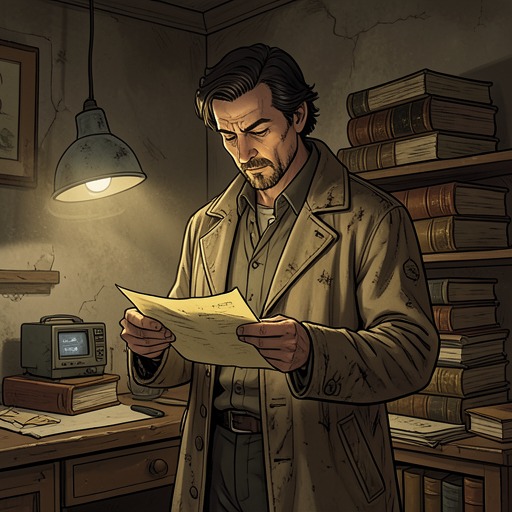
In June 1923, a friend of Bigheart urgently summoned W. W. Vaughan to Oklahoma City. Bigheart, then forty-six, had been rushed to a hospital with suspected poisoning. The friend said Bigheart had information about the Osage murders but would speak only to Vaughan, whom he trusted, and urged the attorney to hurry. The appeal made Vaughan the chosen recipient of a disclosure whose contents would never be established in full.
Bigheart was still conscious when Vaughan reached the hospital. Other people were in the room, but Bigheart motioned for them to leave; he apparently then shared information and incriminating documents with Vaughan. Vaughan stayed beside him for several hours, until Bigheart was pronounced dead. The account does not reproduce what Bigheart said or specify what the documents contained, preserving a decisive gap between the confidence placed in Vaughan and the evidence that survived.
After Bigheart’s death, Vaughan telephoned the new Osage County sheriff. He said he had all the information he needed and was rushing back on the first train. When the sheriff asked whether Vaughan knew who had killed Bigheart, Vaughan answered that he knew more than that. He then boarded an overnight train, but did not arrive at its destination: the next day, his body was found beside the tracks, and the documents Bigheart had entrusted to him were gone. The sequence transformed Bigheart’s final disclosure into a second mystery, joining the suspected poisoning of the man who held the information to the disappearance of the attorney carrying it.
The later investigation into the missing evidence did not resolve what Bigheart had revealed. A justice of the peace, asked whether Vaughan had known too much, agreed and added that he had valuable papers on his person. Decades later, Vaughan’s family preserved an informant’s statement that he had said he collected sufficient evidence to put William K. Hale in the electric chair. That recollection indicates the potential force of the material, but does not establish exactly what Bigheart disclosed or prove who caused either man’s death.
The Archival Trail and Unresolved Suspicion
Decades later, a review of court and Bureau of Investigation records placed Bigheart’s death within a wider pattern of suspected financial exploitation. A grand jury’s secret testimony from 1926 showed that H. G. Burt had recommended another Indigenous person as a target for an insurance scheme. A Bureau informant described Burt and William K. Hale as close associates who had divided money obtained from Bigheart. The records also showed that Hale claimed $6,000 from Bigheart’s estate using a bogus creditor’s note; investigators considered whether the money Burt had tried to obtain was part of the same proceeds.
The estate records complicated any simple account of who benefited from Bigheart’s death. His fortune passed to his wife and young daughter, rather than to Hale or another white man, but Burt became the daughter’s guardian and thus gained control over her funds. Government records showed that Burt had also acted as guardian for several other Osage people, including one who had died. A local lawman’s account placed both Burt and Hale among visitors to Bigheart shortly before his death, when Bigheart was suffering from apparent poisoning. The convergence raised suspicion, but did not establish who poisoned him or what role either man played.
The financial evidence offered no conclusive motive: compared with the headrights at stake in other murders, the sums linked to Bigheart were relatively small, and the United States Department of Justice did not prosecute Hale for Bigheart’s killing or pursue Burt further. Bureau agents nevertheless regarded Burt with deep suspicion, and records showed that he had taken money Bigheart intended for Vaughan. These findings make Burt a possible link between Bigheart’s death and Vaughan’s disappearance, not a proven killer. The surviving trail consists of suggestive associations, diverted money, and missing testimony—the very evidence gaps that keep Bigheart’s last disclosure from becoming a fully reconstructed account.
The Unfinished Investigation
The later account places Bigheart’s death among the unresolved cases that remained after authorities declared the investigation closed. The Bureau had not connected William K. Hale to all twenty-four murders, and the account asks who had killed the men outside the circle of suspects already pursued—including the attorney carrying Bigheart’s papers. That question matters to Bigheart’s story because his final disclosure was followed not by a completed prosecution but by the disappearance of its intended witness and evidence.
Further archival findings sharpened, but did not settle, the suspicion surrounding H. G. Burt. A newspaper account placed Burt aboard the train with W. W. Vaughan and reported that Burt later disclosed Vaughan’s disappearance. Notes from an unpublished interview with a town marshal also implicated Burt and said a local mayor had helped throw Vaughan from the train; the marshal recalled that Burt feared the Bureau’s investigation and moved to Kansas in 1925. These accounts concern Vaughan’s killing directly and do not establish what happened to Bigheart. The narrator explicitly recognizes the limits of accusing a dead man who cannot answer or defend himself. Bigheart’s story therefore remains bound to a chain of testimony that points toward possible connections while leaving the central disclosures, and the circumstances of his death, incompletely known.